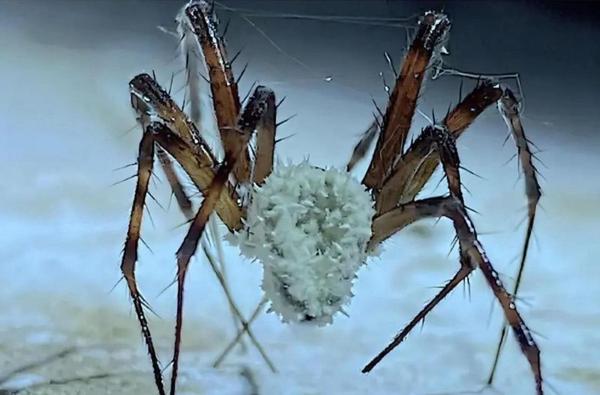
A newly identified fungal species, Gibellula attenboroughii, has been discovered infecting cave-dwelling spiders across Ireland, effectively turning them into “zombies.” Named in honor of Sir David Attenborough, this fungus was first observed in 2021 during the filming of the BBC’s “Winterwatch” series in a Victorian-era gunpowder store at Castle
Espie, Northern Ireland. Researchers found an orb-weaving cave spider (Metellina merianae) covered in a fluffy white fungus, which subsequent analysis confirmed as a previously unknown species.
Following this initial discovery, speleologist Tim Fogg identified additional instances of infected
spiders in various cave systems throughout Northern Ireland and the Republic of Ireland. Notably, these spiders, typically reclusive and hidden in their webs, were found exposed on cave walls and ceilings. This unusual behavior suggests that the fungus manipulates the spiders, compelling them to leave their lairs and move to elevated, open locations. Such positioning likely facilitates the effective dispersal of fungal spores through air currents within the caves.
The behavioral manipulation exhibited by G. attenboroughii parallels that of the well-documented “zombie-ant” fungus (Ophiocordyceps unilateralis), which similarly alters its host’s behavior to enhance spore distribution. In the case of the spider-infecting fungus, it is hypothesized that G. attenboroughii produces
metabolites, possibly including dopamine, that influence the spiders’ nervous systems, driving them to act against their natural instincts. This discovery not only adds to the known diversity within the genus Gibellula in the British Isles but also underscores the need for further research into the ecological roles and population impacts of such parasitic fungi on their arachnid hosts.
The identification of G. attenboroughii highlights the complex interactions between parasites and hosts in subterranean ecosystems. As researchers continue to explore these relationships, they aim to deepen our understanding of the mechanisms underlying such behavioral manipulations and their broader ecological implications.